How Seek Outside Shelters Perform in Extreme Wind (50–65 MPH Field Test)
Posted by Ryan Sapena on 12th May 2026
Every spring in western Colorado, high winds roll through our part of the state—and this year, we used it as an opportunity to push our gear to the limit.
At Seek Outside, we design ultralight backpacking shelters, backpacking tipis, and backcountry hunting tents built for extreme environments. We test our gear rigorously every year but this year we wanted to document it for you all to see, as well as give some tips and tricks on camping in extreme winds.
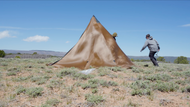
We tested multiple flagship Seek Outside shelters in sustained 50–55 mph winds with gusts over 60 mph—in probably the worst place you could possibly pitch a tent…
Why We Test Seek Outside Shelters in Extreme Wind
The fact of the matter is that even the cheapest box store shelter will hold up in 75% of conditions. We also know that our employees and customers are the ones crazy enough to try and withstand the other 25% for the sake of seeing what’s over that next ridge.
We test ultralight hunting shelters and backcountry tents in these conditions—because that’s where failure actually happens.
This field test included:
- Guardian 2.0
- Brightwater
- 8-Person Tipi
- Redcliff
- Cimarron
These are proven floorless shelters for backpack hunting and backcountry camping shelters.
Setting Up a Backpacking Shelter in High Wind
When pitching a backpacking tipi or ultralight tent in wind, your setup will never be perfect. To maximize efficiency, aim for the highest quality pitch achievable.
Key challenges:
- Uneven tension on certain seams.
- Difficult staking
- Reduced structural symmetry
This is especially true with larger shelters or asymmetrical designs like the Guardian. Having a partner there to help can be essential. If at all possible, try and pitch the shelter in a lul in the weather or be prepared to adjust the pitch when things calm down.
Best Way to Set Up a Tent in Wind
Always point the narrowest, most aerodynamic side of your shelter into the wind.
This applies to:
- Backpacking tipis
- Floorless hunting shelters
- Ultralight trekking pole tents
Why:
- Reduces wind resistance or wind footprint
- Improves stability
- Prevents panel collapse
Stakes & Guy-Outs: The Most Important Factor
Your shelter fabric isn’t usually the weak point—your stake system is. When facing high winds, you shouldn't compromise on stability by opting for a subpar stake kit just to save weight.
For this test, we used:
- 10” twisted stakes (Nessecity for these conditions)
- Full guy-out configurations
Pro Tip:
Twist the stake loop once before driving it in—it locks tension more securely. If you are utilizing line loc extensions, tie a small knot in the upper cordage to keep the cord from slipping.
Advanced Setup Trick: Guy-Out Redirects
A key technique we use almost always when guying out a tent is:
Guy-out redirects
Benefits:
- Better tension angle
- Increased headroom
- Reduced sag
- Improved wind stability
Seek Outside Shelter Wind Test Results
Brightwater
- Extremely stable
- Tipi-style shape sheds wind well
- Ideal for solo backcountry trips
Guardian 2.0
- Set up in worst-case orientation
- Still held strong
- No structural failures
Cimarron
- Low profile = excellent wind resistance
- Minimal movement
- Proven over years of use
Redcliff
- Larger footprint
- Slightly more movement
- Very stable when guyed out
8-Person Tipi (Extreme Load Case)
- Carbon pole failure under extreme gust
- Guyline snapped under heavy load
- Shelter remained intact
Design principles:
Poles fail before the shelter does—field-repairable > catastrophic shelter failure. We also intentionally sew our tents in a way that gives them more stretch. Just like having shocks on your mountain bike, this principle reduces seam failures.
Carbon vs Aluminum Poles
Carbon Fiber:
- Lighter
- Strong
- Fails completely (splinters)
Aluminum:
- Heavier
- Bends instead of snapping
Tip- If using carbon fiber in high winds, try lowering the adjuster a click or two. This gives the pole more play.
Hot Tents in High Wind
Avoid running a stove in 40–60 mph winds.
Risks:
- Fabric damage
- Fire hazards
- Structural collapse issues
Remove the stove pipe and damper from the stove and set the pipe inside the shelter. This will keep the stovepipe from moving around and cutting the stove jack.
Campsite Selection: The Easiest Advantage
Moving just ~100 yards into cover:
- Cuts wind dramatically
- Improves safety and comfort
Look for:
- Trees (pinyon, juniper, oak brush)
- Terrain breaks
- Natural wind barriers
Avoid:
- Ridge tops
- Fully exposed areas
- Dead trees (widow makers)
Final Thoughts
In extreme wind, your shelter becomes your safety system. There is not a single ultralight tent fabric out there that performs like our custom Sil-Nylon. We have tried them all… We truly believe in our design and testing process and we have thousands of customers who would agree.
At Seek Outside, we build gear designed for worst-case scenarios—not ideal conditions.
This test reinforced a simple truth:
? A well-designed shelter + proper setup = confidence in any weather
…